
Personal Testimony
Mighty in Word, Not Mighty in Writing
How the book, the articles, the podcast, and the videos actually get made
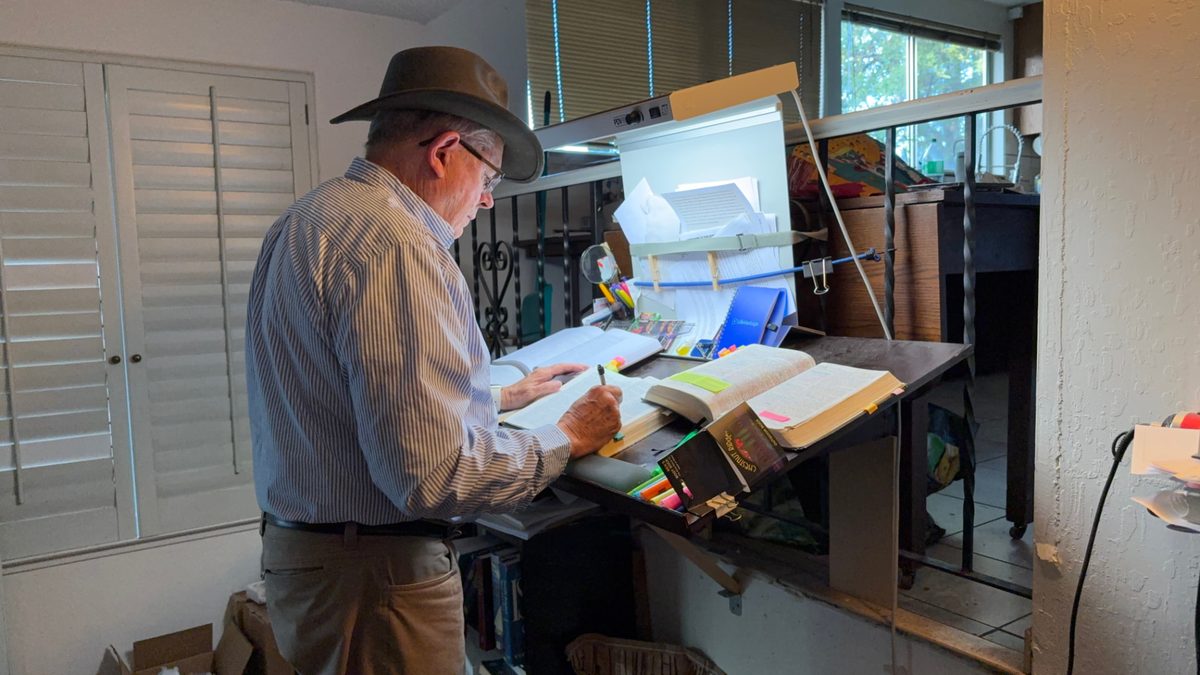
Here I am at my hand-built scripture table so I can read while standing.
Moroni wrote something near the end of his life that I read for forty years without ever really stopping on it. Then I tried to write a book, and I understood it inside of a week. He had spent his whole life preaching. He could open his mouth in front of people and the words came, because the Holy Ghost gave them to him and he never had to hunt for them. Then he sat down with a sheet of metal and a tool in his hand, and everything changed. What ended up on the plate was not what he had felt in his chest. He knew it. And it bothered him enough that he took it to the Lord and said so out loud.
"And I said unto him: Lord, the Gentiles will mock at these things, because of our weakness in writing; for Lord thou hast made us mighty in word by faith, but thou hast not made us mighty in writing; for thou hast made all this people that they could speak much, because of the Holy Ghost which thou hast given them; And thou hast made us that we could write but little, because of the awkwardness of our hands. Behold, thou hast not made us mighty in writing like unto the brother of Jared, for thou madest him that the things which he wrote were mighty even as thou art, unto the overpowering of man to read them. Thou hast also made our words powerful and great, even that we cannot write them; wherefore, when we write we behold our weakness, and stumble because of the placing of our words; and I fear lest the Gentiles shall mock at our words." (Ether 12:23–25)
Stumble because of the placing of our words. I am not putting myself anywhere near Moroni and I want that understood before I go one sentence further. But the gap he is describing is a real gap, and anybody who has ever tried to take a spiritual experience and turn it into paragraphs has stood in the middle of it. I can talk for an hour without a note in front of me. Put me in front of a blank page and ask me to arrange four months of revelation into chapters that a stranger can follow, and I am a different man entirely. People keep asking me how this work actually gets made, so I am going to tell you the whole thing, start to finish, including the parts nobody asks about and the part where I uploaded the same book to Amazon twenty-four times.
Where the material comes from
From December of 2024 through March of 2025, I got up at 3:30 in the morning and sat down at this computer in the dark. My scriptures were not open. I did not have a commentary propped up next to the keyboard, or a study manual, or a video paused on the other screen. I sat here and I dictated, and the thoughts came faster than I could get them into Scrivener. Four months of that. Some mornings I would finish and look at the screen and not remember producing half of what was on it. And I want to be exact about this, because it matters later. I did not write a single line of a book before that December. Everything up to that point was note taking, and before the notes there was only a question I could not put down. The writing started in December of 2024 and the first edition came out of those four months, with additions continuing through July of 2025.
Now let me tell you about my library, because it matters and because somebody is going to ask. I own about twenty commentaries on Isaiah and sixteen on the book of Revelation. I have not read every one of them cover to cover, but I have read portions of each. Between December of 2022 and December of 2024 I consulted a great many of them, trying to understand as much about Revelation as I possibly could. After December of 2024 I stopped completely. Nothing I dictated in those four months came out of those books, or out of a talk, or a video, or a podcast. And to this day I cannot read them anymore. The ones I read are outdated. I appreciate those writings for their time, and I am grateful for the men who did that work, but things are being revealed now exactly as we were promised they would be. We were told that when the writings of John began to unfold, we would understand them. The same is true of Isaiah. Everything after December of 2024 was pure inspiration from God, and 100% original.
That is also why I keep pointing readers back to the scriptures rather than to me. Forty years of reading the Book of Mormon every single day is the only credential I have, and it is the only one that matters for work like this.
The first edition, and the two exceptions
All of that dictation became the first edition. Every word of it is mine, spoken out loud and then cleaned up with Grammarly for spelling and grammar. There are two exceptions and I am going to name them both. There is one paragraph in that entire book where I consulted AI because I could not get the language right no matter how many times I said it. And there is Chapter 7, called the Seven Sevens of God, where I used AI to organize a very large volume of scripture into a workable structure. That chapter is short and there is hardly any prose in it. It is almost entirely scripture arranged in order. That is the whole extent of it.
I should mention the one other tool I tried, because it cuts the other direction. Somebody told me about a program called Sudowrite that was supposed to help me write the book, so I went and got it. It may well be a fine thing for a romance or a mystery. For a book that has to be doctrinally accurate it was horrible, and I abandoned it almost immediately. It could not tell the difference between something that was true and something that merely sounded good, and in this subject that difference is the whole ball game. Apart from the two exceptions I just named, nothing AI-related touched that first book at all.
I could leave both of those out and not one person on earth would ever find them. But if I am going to ask you to believe me about something as large as what the scriptures say about the first horseman, then I had better be the kind of man who volunteers the small things without being asked. So there they are.
Twenty-four times
In April of 2025 I uploaded the book to Amazon and told my family I was finished. I was not finished. About a week later more inspiration came, and I had to go back into the book and change it. Now understand what changing it actually meant. I had a paperback, a hardback, an e-book, an audiobook, and at that time a flipbook. Five versions. Every correction had to be made five times, and the audiobook was a nightmare all by itself, because you cannot simply retype a sentence in an audiobook. I had never published anything before in my life. Not one thing. I had done a great deal of typesetting over the years, so I laid the whole book out myself in Adobe InDesign and learned the rest of the process as I went, including the parts I did not know existed until they broke. The first edition also carried a number of illustrations, and those have all come out since, for reasons that would take their own article.
So I uploaded it again. A week after that, more came, and I changed all five versions again and uploaded it again. Then it happened again. I kept deciding I was done and God kept deciding I was not, and by the time that stretch was over I had uploaded that book to Amazon twenty-four times. Twenty-four! I do not recommend it to anybody. By July of 2025 I was certain, completely certain, that the thing was finished. About a month and a half later I found out I was wrong again, and that is actually when this website started, because I decided that instead of tearing the book apart for the twenty-fifth time I would put the new material into videos and articles where it could reach people without costing me another week in InDesign.
The second four months
The inspiration did not slow down. It picked up. And by December of 2025 I understood that articles were not going to hold it, and that the book itself had to be rewritten from the ground up. Then something happened that I still do not know how to explain properly. I got another four months. December of 2025 through April of 2026, almost the same stretch of the calendar as the year before, and it came in like a fire hose exactly the way it had the first time. I learned things in those four months that I had not learned in forty years of daily reading.
New here? I give away Chapter 8 of my book, the one I get asked about more than any other. It makes the scriptural case that the seven seals haven't opened yet, one of the more provocative claims I make. Join the newsletter and it's yours. Get the Free Chapter →
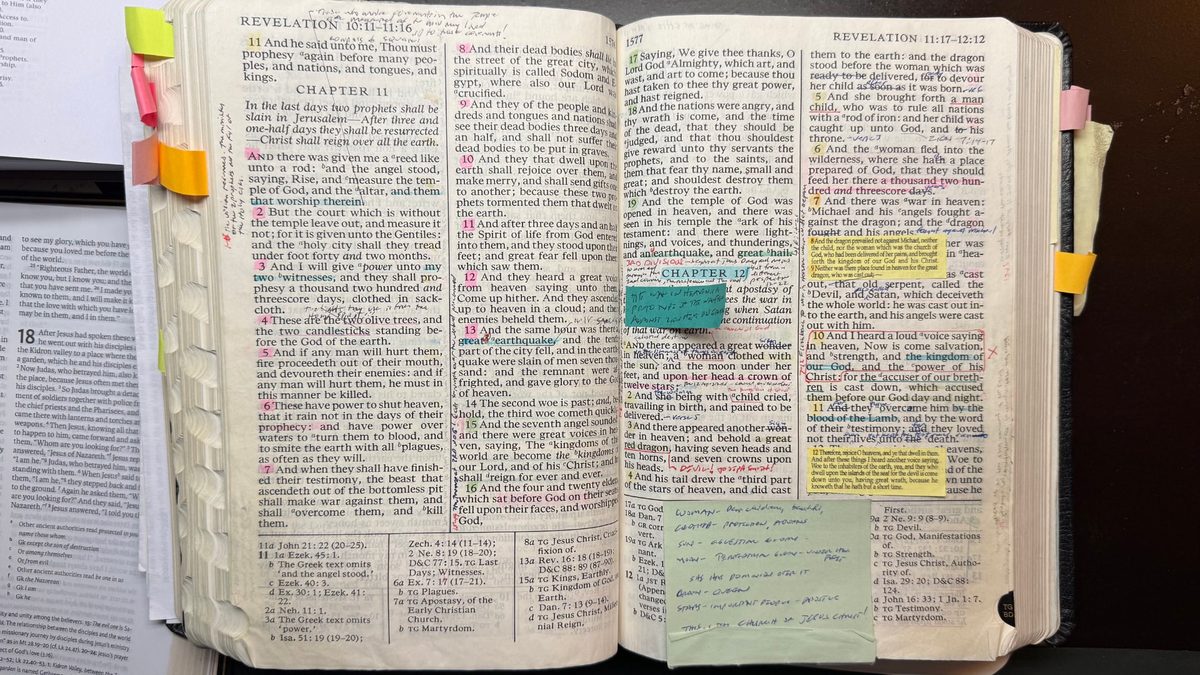
There was one day in there I will never forget as long as I live. I was enveloped by the Spirit for the entire day, and by the end of it I finally understood the twelfth chapter of Revelation. It was glorious while it was happening and it made me weep for days afterward, and it changed the book completely. I need to tell you why, because it is the honest center of all of this. When I first started writing, I thought this was going to be an interesting project. Here is where Trump shows up in this verse in Isaiah, and here is another one in Revelation, and here is one in the Book of Mormon, and look how they fit together. It was almost fun. After that day it was not a project anymore. It became a rescue mission. I still get choked up thinking about what I was shown, and I have never once been able to go back to treating it as a puzzle.
Line upon line, and a drive to Portola
Here is something I did not expect, and it is the part I most want you to take with you. The understanding did not arrive finished. It arrived in layers. I would see something, write down what I understood, and come back weeks later and see more in the same verse, and then more after that. Again and again and again. For a long time I wondered whether that meant I had gotten it wrong the first time. Then I noticed that the Savior does it on purpose.
In Third Nephi, He gives the people an overview of the whole sweep of history He wants them to understand. Then He looks at them and sees that they are finished. It is late in the day, they have been through more in a few hours than most people experience in a lifetime, and they cannot hold any more.
"I perceive that ye are weak, that ye cannot understand all my words which I am commanded of the Father to speak unto you at this time. Therefore, go ye unto your homes, and ponder upon the things which I have said, and ask of the Father, in my name, that ye may understand, and prepare your minds for the morrow, and I come unto you again." (3 Nephi 17:2–3)
He comes back the next day and teaches that same material again, and the second version runs for chapters and chapters with detail He had not given them before. Same doctrine. Far more of it. The difference was not in Him. The difference was in what they were prepared to receive after they had gone home and pondered it and asked the Father about it. That is exactly what kept happening to me, and once I saw it in Third Nephi I stopped being troubled by it.
And it did not always come at my desk. One afternoon my wife and I were driving the Jeep over to Portola, California, nothing special about the day at all, and the meaning of a verse in Revelation 9 settled on me, calm as anything.
"And they had hair as the hair of women, and their teeth were as the teeth of lions." (Revelation 9:8)
The hair is the Nazarite vow. It is Samson. Long hair on a man under that covenant is the outward sign of a man consecrated to God, and as long as Samson kept the vow there was no army on earth that could put him down. These are not soft creatures John is describing. They are consecrated men, and they cannot be defeated. I had read that verse my whole life and never seen it. I saw it on a highway in a Jeep with my wife next to me.
That is why I carry a Plaud recorder now. Insight comes on walks. It comes in the car. It comes in the middle of scripture study when I am reading about something else entirely. There are hundreds of notes in my phone from before I had anything better, and the phone worked, but the recorder is far better at capturing exactly what I said and keeping it organized. Those files are timestamped and dated, which means there is now a record of my own voice saying these things out loud before anything else ever touched them.
What an editor actually does
Here is the part people want to know about, so I will be plain. I upload my own dictation and my own published book, and I ask for organization and editing. Inspiration does not arrive in order. It arrives in pieces, out of sequence, with the ending sometimes showing up two months before the middle. Somebody has to take a stack of transcripts and put them in a line a reader can follow. That is what an editor does, and it is not a new arrangement.
"Then Jeremiah called Baruch the son of Neriah: and Baruch wrote from the mouth of Jeremiah all the words of the LORD, which he had spoken unto him, upon a roll of a book." (Jeremiah 36:4)
Jeremiah did not stop being the prophet because Baruch held the pen. Paul dictated his letter to the Romans, and the man taking it down got a line of his own right in the middle of the greetings, which has always struck me as one of the most human moments in the New Testament.
"I Tertius, who wrote this epistle, salute you in the Lord." (Romans 16:22)
And then there is the one closest to home for us. Joseph Smith dictated the entire Book of Mormon, and Oliver Cowdery wrote the majority of it down. What most members never hear is what that manuscript looked like when it reached the printer. There was essentially no punctuation in it anywhere. The typesetter at the Grandin shop, John Gilbert, who was not a member of the Church, later said that every chapter came to him as one solid block from beginning to end without a punctuation mark in it, and he added something on the order of thirty thousand of them so the rest of us could read the thing. A prophet translated it. A scribe wrote it down. A hired typesetter punctuated it and broke it into paragraphs. The book is no less true for any of that.
So when I tell you that Claude is my editor, understand exactly what I mean and what I do not mean. It does not get to have an opinion about Isaiah. It does not get to decide what the white horse represents. It does not get to add a source, a commentary, a quotation, or an argument I did not give it. When it tries, and it has tried, I take it out. Every sentence in that book is either a sentence I dictated or a sentence I read, weighed, and kept, and every decision about what belongs where and what comes out is a decision I made. Proposals come back to me. I am the one who says yes or no, and I have said no a great many times.
What I want understood most is how much back and forth is involved, because "AI wrote it" and what actually happens in this office are not remotely the same activity. We argue. I send a section, I get back a draft, and I tell it the doctrine is wrong and explain why, and send it again. Sometimes it pushes back on me and it turns out to be right, and I have had to go check a date, or a verse, or a claim I was sure of, and change it. Sometimes we go six or seven rounds on a single idea before the meaning finally sits correctly on the page. I have corrected its doctrine more times than I can count. I have corrected its voice more times than that. And it has caught errors of mine that would have embarrassed me in print, which is worth something too.
The volume is hard to describe. There are thousands of pages of my own material sitting in that project now, far more than what was in the original book. The rewrite came in at over six hundred pages, and you cannot hand a general reader a six-hundred-page book, so I set a target of four hundred and asked for help finding what could come out. We cut it back. Then more inspiration came and I poured more in, and it was six hundred again. We cut it back again. I poured more in again. I finally pulled every appendix out of the book and put them online for readers, and it still climbed back over six hundred. We went through the entire manuscript one more time looking for anything repeated, anything slow, anything that could be said in fewer words, and got it to four hundred and two pages. And even as I dictate this, there are things I want to add. That is the honest state of it.
Study it out in your mind
Looking back, the one thing I wish I had done differently is record those 3:30 in the morning sessions in audio. I have them in digital form, but I would give a great deal to hear them. Those were glorious days and they were also the hardest mental work I have ever done in my life, and I need both halves of that sentence to land, because people hear the first half and quietly delete the second one. The Spirit of God was poured out on me during those two four-month stretches. I have said so in the book and I will say it again here. And I still had to work. Ideas came into my mind that I had never heard from any man, and then I had to sit there and labor over how what I was being given applied to the verse in front of me, usually somewhere in Revelation, and I asked myself that question a hundred times a day. People assume that inspiration means sitting still while something gets poured into you. It was poured into me, and I had to fight for every piece of it. Maybe audio would not have captured that anyway. There was so much wrestling and circling back that a recording might have sounded like a man muttering at a screen for four hours.
Most of the time during those sessions I did not have my scriptures open in front of me, and I want to explain that rather than let it sit there sounding careless. I read my scriptures every day, and have for forty years, sometimes for several hours at a stretch. There were many times in the middle of this process when I would stop dictating and go stand at my scripture table and read. And what happened at that table is the part I most wish I could hand to somebody. I would stand there knowing that something was coming and not be able to get hold of it. So I would read the verse again. And again. I have read single verses hundreds of times, turning them over on a walk, coming back to them the next morning and the morning after that, and sometimes it took a week. Sometimes two weeks. Sometimes three. And then it would open. It was like a man walking into a dark room and finding the switch, and it was glorious!
I also want to say plainly what did not happen, because when a man writes about revelation other people will fill in the blanks for him and they will not fill them in modestly. I have never seen an angel. I have never had a vision. I have heard the voice of God the same way every other member of this Church hears it, which is the still small voice, and that promise is open to anyone willing to quiet down and listen for it. Nothing came to me that is not on offer to you.
Oliver wanted that gift. He asked for it, the Lord gave him the chance to try, and he could not do it. The revelation he received afterward explaining why has become one of the most personal passages in all of scripture to me.
"And, behold, it is because that you did not continue as you commenced, when you began to translate, that I have taken away this privilege from you. Do not murmur, my son, for it is wisdom in me that I have dealt with you after this manner. Behold, you have not understood; you have supposed that I would give it unto you, when you took no thought save it was to ask me. But, behold, I say unto you, that you must study it out in your mind; then you must ask me if it be right, and if it is right I will cause that your bosom shall burn within you; therefore, you shall feel that it is right." (Doctrine and Covenants 9:5–8)
You took no thought save it was to ask me. I know what those verses feel like from the inside now, and I know what the mental exertion costs. And I want to be careful here, because I have no interest in setting myself up as a man who cannot be wrong. I am not a prophet. I hold no keys. I have never claimed either one, and the question of who receives revelation for whom deserves a straight answer from me rather than a dodge. I have changed numerous things in this book as I have gone, and I have said so publicly every time I did it. Things were revealed to me over time, in layers, the same way the Savior taught the Nephites over two days, and more than once the later layer corrected what I thought I understood in the earlier one.
The strangest part is that I cannot do it now. It was given to me for a season, the season closed, and I knew when it closed. But I do not read the scriptures the same way anymore and I never will again. I stop on single words now. I will sit on one phrase for twenty minutes, because I know from experience that there is far more behind it than most people realize.
About the detectors
Somebody is going to run this article through an AI detector and post the screenshot, so let me deal with it now rather than argue about it later. Start with what those tools actually measure, because almost nobody who posts a screenshot knows. They measure how predictable a piece of writing is. That is the whole trick. They look at word choice and sentence rhythm and ask whether each next word is the word a machine would most likely have picked, and then they hand you a percentage. Predictable prose scores high. Editing makes prose more predictable, which is exactly what editing is for, and I have told you plainly that my work is edited. Students have been accused over nothing worse than running Grammarly on a paper they wrote themselves.
But here is the part that matters. No detector on earth can measure where an idea came from. There is no tool that can look at a sentence and tell you who first saw the connection between a verse in Isaiah and a verse in Revelation at 3:30 in the morning. A score tells you something about sentence rhythm. It tells you nothing whatsoever about authorship, and authorship is the only question anybody is actually asking.
So if the question genuinely matters to you, look at evidence rather than a percentage. There is dated audio of my own voice saying these things out loud before anything else ever touched them. There is version history going back to the first morning. There are twenty-four uploads to Amazon spread across months, which is what a man revising his own book looks like and is not what anything else looks like. There is a copyright registration. I have written before about people who have already decided before they read a word, and for them no amount of evidence was ever going to settle anything. For everybody else, the evidence exists and I am glad to show it.
So let me end where I should end. The ideas in these articles and in that book are mine. The scriptural connections are mine. The arguments are mine, and they are mine because they were given to me by God over years of asking, and because I then spent years testing them against the scriptures and against the teachings of the Church. The arrangement had help. The spelling had help. The placing of the words, to borrow Moroni's phrase, had help. I have now told you the tool I use, the two places in the first edition where the line moved, how many times I uploaded that book to Amazon, and how many rounds it takes to get a single idea right. You know more about how this book was made than you know about almost any book on your shelf.
And now let me tell you what to do with it, because it is not what people expect an author to say. Do not pray about my book. I am not a prophet, this is not the Book of Mormon, and I have no business asking the Lord to put His stamp on my work for you. Pray about the scriptures instead. Go to the verses I point you toward, in Isaiah and in Revelation and in the Book of Mormon, study them out in your mind, and take those to the Father. If what I have written is true, the scriptures themselves will tell you so and you will not need my testimony to know it. If it is not true, you will have spent the afternoon in the scriptures, which is no loss to anybody.
In the name of Jesus Christ, amen.
Keep Reading
- The Four Horsemen of the Apocalypse: What Each One Actually Represents
- How to Avoid Deception
- What You Believe Colors Everything You See
Kelly Smith is the author of The First Horseman, Donald Trump and Biblical Prophecy. He is a lifelong member of The Church of Jesus Christ of Latter-day Saints and has read the Book of Mormon daily for more than forty years. Find the book, the podcast, and the full article library at FirstHorseman.World.
Before You Go
Want the full case in one place?
Start with my free chapter, What Seal Are We In?, and I'll send a note whenever I publish something new.
Get the Free ChapterHave a thoughtful question? I read every one. Submit a question →